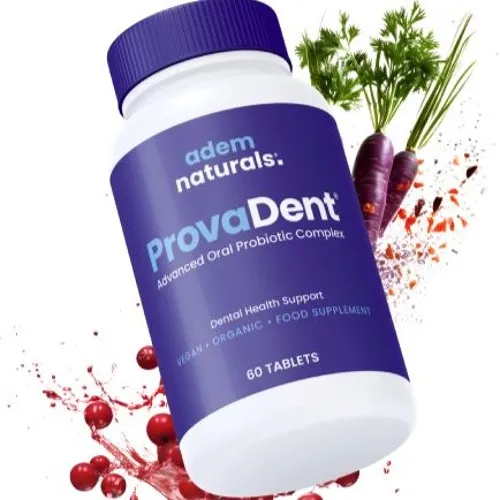
Full ProvaDent Ingredient List
| Ingredient (as listed on seller pages) | What it is | What research says (in short) |
|---|---|---|
| Four probiotic strains (names vary by page) | "Good" bacteria for the mouth | Oral probiotic research is promising but weak overall; results depend on the exact strain |
| Organic xylitol | Sugar alcohol that mouth bacteria can't ferment | A 2015 Cochrane review found little high-quality evidence it prevents decay; little or no evidence for xylitol tablets or lozenges |
| Cranberry extract | Fruit polyphenols | Mainly lab research on bacteria sticking to teeth; human evidence is limited |
| Purple carrot powder | Plant powder with anthocyanins | No meaningful oral-health evidence we could find |
| "BioFresh Clean Complex" | Proprietary blend | Contents and doses not disclosed, so it can't be assessed |
Xylitol: The Evidence
Xylitol can't be fermented by decay-causing bacteria, which is why it's in many sugar-free gums. But a 2015 Cochrane review found only low-quality evidence for xylitol toothpaste and little or no evidence for xylitol tablets, lozenges or syrups preventing decay.
The Proprietary Blend Problem
Because doses are hidden in a blend, nobody outside the company can check whether each ingredient is present at a meaningful amount.
Check the current price and refund terms on the official site.
Ingredient Claims vs Evidence
| Claim on ProvaDent pages | What the evidence says |
|---|---|
| "Xylitol reduces acid-producing bacteria by up to 90%" | No source given. Xylitol can lower mutans streptococci, but Cochrane found little high-quality evidence it prevents decay, and little or none for tablets |
| "Xylitol improves digestion, weight loss and immunity" | Not supported for a daily supplement; in larger amounts xylitol can cause loose stools |
| "Four clinically proven probiotic strains" | The strains aren't consistently named, so they can't be matched to any study |
| "Purple carrot is rich in vitamins that promote healthy teeth" | No meaningful oral-health research we could find |
| "BioFresh is an enzyme combination" | Contents and amounts aren't disclosed |
Xylitol in More Detail
ProvaDent's xylitol is described as organic and birch-derived. Xylitol is widely used in sugar-free gum because mouth bacteria can't ferment it into acid, and chewing gum also boosts saliva. A 2017 meta-analysis found xylitol lowers mutans streptococci in plaque and saliva. But the 2015 Cochrane review concluded there was little high-quality evidence that xylitol prevents decay, and its benefit seen in some studies came mainly from xylitol toothpaste and chewing gum, not from capsules or tablets. Studies that showed effects used several exposures a day, not one.
The Four Probiotic Strains
Most ProvaDent pages say there are "four strains" without naming them, while some describe them as producing "antimicrobial peptides". Without strain names, codes and doses, it's impossible to say whether they match any published research. This is a bigger gap than with ProDentim, which at least names its species. If you contact support, ask for the full strain names and CFU per serving.
Ingredients That Appear on Only Some Pages
A few pages add magnesium, potassium, zinc, calcium or vitamin D3, or describe cranberry juice rather than extract. Others say the formula was created by a "Dr. Knudson", whom we couldn't verify. Treat these as unconfirmed until you see them on the label of your bottle.
Dose and Format
Most pages describe 60 capsules per bottle, taken two a day; some describe one chewable a day. One page warns not to take more than two capsules a day. Follow your bottle's label, and if it says capsules, note that the probiotics will spend little time in your mouth.
ProvaDent vs Dentabiome Ingredients
| Ingredient | ProvaDent | Dentabiome |
|---|---|---|
| Bacteria | Live (4 unnamed strains) | Inactivated L. plantarum, L. salivarius, L. rhamnosus |
| Xylitol | Yes | Yes |
| Cranberry | Yes | Yes |
| Purple carrot | Yes | Yes |
| BioFresh Clean Complex | Yes | Yes |
Both come from Adem Naturals. See Dentabiome ingredients.
What to Check on the ProvaDent Label
- Full names of the four probiotic strains, ideally with strain codes.
- CFU per serving, guaranteed to expiry.
- Amount of xylitol per serving.
- Capsules or chewables, and how many per day.
- "Other ingredients", allergens and storage advice.
- Company name, lot number and expiry date.
Our Verdict on ProvaDent's Formula
ProvaDent's formula sounds reasonable — probiotics plus xylitol plus cranberry — but it's one of the least transparent of the products we've reviewed: unnamed strains, hidden doses and a proprietary blend. Its most researched ingredient, xylitol, works best in gum and toothpaste, not capsules. If you value ingredient transparency, this is a weakness.
ProvaDent FAQ
Does ProvaDent contain sugar?
It uses xylitol, a sugar alcohol. Check the full label for other ingredients if you have allergies.
Does ProvaDent contain zinc or vitamin D?
A few pages say so; most don't. Check the label.
Who created ProvaDent?
Some pages credit a 'Dr. Knudson'; we couldn't verify this. Brand materials name Adem Naturals.
Is ProvaDent's xylitol from birch?
Some pages describe it as organic, birch-derived xylitol. Check the label.
Sources
- Riley et al. 2015, Xylitol-containing products for preventing dental caries (Cochrane)
- NIH Office of Dietary Supplements: Probiotics Fact Sheet
- NCCIH: 5 Things To Know About Probiotics
- Akram et al. 2020, Probiotics for gingivitis: systematic review (Aust Dent J)
Product details are taken from seller pages and may change. Last checked 2026-11-16.
Check the current price and refund terms on the official site.
Related ProvaDent Research
Other dental supplement reviews: ProDentim Reviews · Dentatonic Reviews · Dentabiome Reviews · Dentitox Pro Reviews · Dental Health hub
Guides: Dental supplements · Dental probiotics · Gum supplements · Teeth supplements · Bleeding gums · Bad breath